
Occupational Therapy
Eurythmy Therapy and Occupational Therapy both aim to support health, functioning, and wellbeing, but they arise from very different medical traditions and use very different methods. Eurythmy Therapy is a movement‑based modality within Anthroposophic Medicine, its aim is to activate intrinsic healing forces and support balanced health, while Occupational Therapy is a mainstream, evidence‑based health profession focused on enabling people to participate in daily life. Despite this, both share a therapeutic intention: improving a person’s capacity to function, adapt, and heal.
Primary Goal:
Eurythmy Therapy:
Stimulates self‑healing processes and supports physiological balance.
Occupational Therapy:
Enables participation in daily occupations (self‑care, work, social life).
Similarities:
Holistic orientation: Both aim to improve overall functioning and wellbeing.
Movement may be involved: OT sometimes uses movement or exercise when it supports daily function; Eurythmy Therapy uses movement as its core modality.
Individualised treatment: Both tailor interventions to the person’s needs.
Applicable across ages and conditions: Both can support children, adults, and older adults with chronic, acute, or developmental challenges.
Therapeutic relationship: Both rely on guided, therapist‑led sessions.
How Eurythmy Therapy & OT can work together
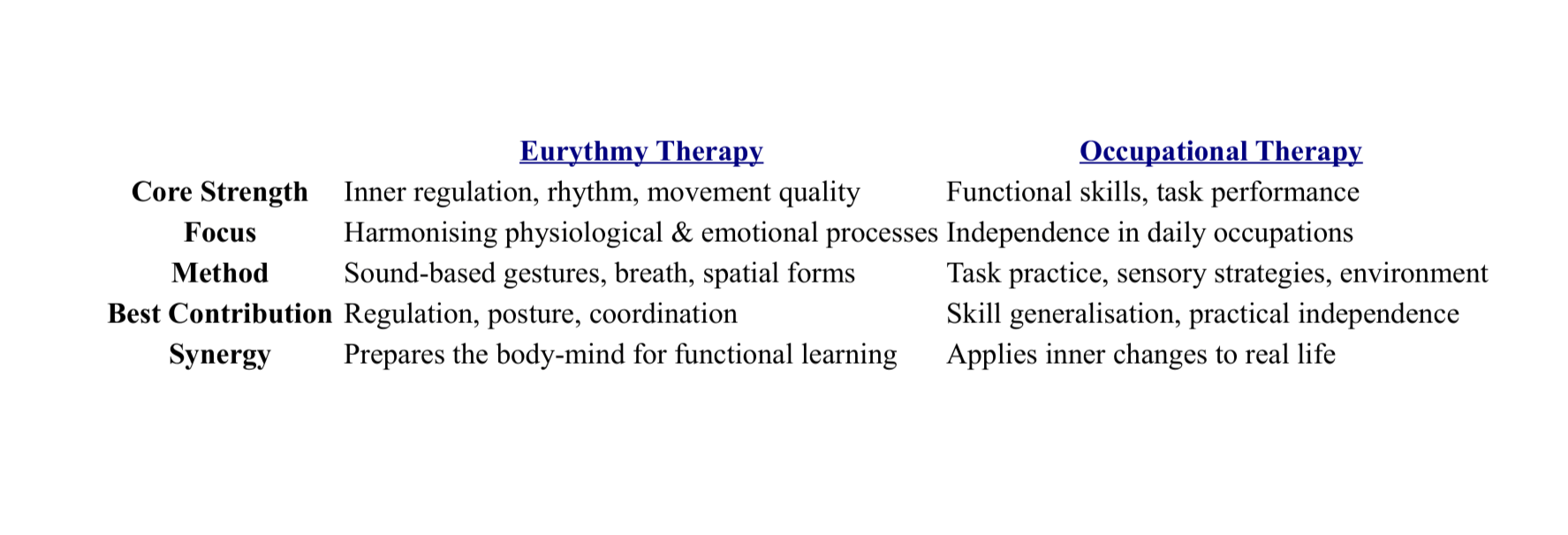
Eurythmy Therapy can complement Occupational Therapy by strengthening the inner regulatory, rhythmic, and postural foundations that OT then translates into functional, real‑world skills. When used together, Eurythmy supports inner coherence, emotional regulation, and movement quality, while OT supports practical independence, task performance, and environmental adaptation. The two modalities reinforce each other rather than overlap.
Differences:
Origin & Framework
Eurythmy Therapy:
Founded in Anthroposophic Medicine.
Uses archetypal movement forms connected to speech and music.
Occupational Therapy:
Rooted in biomedical, psychological, and social sciences.
Uses evidence‑based functional, behavioural, and environmental interventions.
Methods
Eurythmy Therapy:
Structured gesture sequences, rhythm, sound‑based movement.
Focus on internal regulation and organ‑related processes.
Occupational Therapy:
Task practice, environmental modification, assistive technology, cognitive strategies, sensory integration, habit training.
Focus on practical function and independence.
Evidence Base
Eurythmy Therapy:
Growing research especially in Anthroposophical Hospitals in Europe
Occupational Therapy:
Established evidence base across medical and community settings.